FPS Shooting: 3D Sniper Range
- 4.9
- Rating
- 50.00K
- Installs
- Free
- Price
 Analysis by App-foxy
I spent time with FPS Shooting: 3D Sniper Range as a focused sports game built around sniper-rifle marksmanship. Its central appeal is easy to understand: instead of turning shooting into a broad action adventure, it asks you to concentrate on the act of lining up a shot and improving your control. That narrow purpose gives it a different feel from a typical mobile FPS, and it is the main reason I would recommend trying it.
Developed by HuanCai Studio, the game is free to play and sits in the Teen age category. It has reached over ten thousand installs and holds a perfect 5.0 average from around seven hundred ratings, which suggests that the people who have rated it have responded well to its focused approach. I would still treat those figures as a sign of early interest rather than proof that it will suit every player. A sniper-range game lives or dies by how satisfying its aiming feels, and that is a very personal thing.
The current version is 1.08 and it runs on Android 6.0 or newer. That makes it accessible to many older Android devices, although compatibility alone does not guarantee a smooth experience on every phone. I found the best way to approach it was not as a replacement for a large competitive shooter, but as a compact practice-style game for moments when I wanted to focus on precision without learning a huge collection of systems.
You May Also Like

 Blood Strike: 2.5 Anniversary
Blood Strike’s Loadouts Turn Every Drop Into a Tactical Gamble
A close look at Blood Strike’s custom loadouts: how fast access to signature weapons reshapes its battle royale rhythm, rewards preparation, and narrows the gap between fights.

 Pandora - Music & Podcasts
Pandora’s Music Is Easy to Start, but Harder to Recover
Pandora’s strength is its low-effort path from a seed to a station. Its weak spot is how much confidence it asks you to place in connection, setup, and quiet recovery.

 8 Ball Pool
 Is Built on Rivalries, Rematches, and Routine
A close look at the rivalries, rematches, shared routines, and unanswered safety questions that turn a quick pool match into a persistent mobile community.

 Samsung Music
’s Quiet Strength Is Playing What You Already Own
Its reach comes less from spectacle than from dependable access to a personal library. That simplicity is both the app’s strongest retention engine and its ceiling.

 AccuWeather: Weather Radar
AccuWeather Review: A Quick, Clear Forecast for Everyday Decisions
For everyday plans, the best forecast is the one you can understand quickly. AccuWeather makes rain timing, radar, and local conditions easy to act on, with a few trade-offs.

 Hill Climb Racing
Why Hill Climb Racing Still Turns Crashes Into One More Run
A tiny car, a bumpy hill and one more upgrade: Hill Climb Racing keeps resurfacing because its simple chaos makes every near-miss feel personal.
More From Our News Desk



Why the marksmanship focus changes the experience
I find that the marksmanship focus changes the usual mobile-shooter question from “How much action is happening?” to “How carefully can I manage this shot?” That shift makes the game’s small, repeatable goals easier to appreciate, especially when I treat an attempt as practice rather than a score to defend. The same focus also makes its place among other shooting games clearer.
Precision becomes the game rather than a side activity
Most mobile shooting games use aiming as one part of a much busier loop. You move through a map, avoid attacks, switch weapons, watch objectives and react to enemies appearing from several directions. In this game, the appeal is much more concentrated. The rifle and the target occupy most of your attention, so small movements matter more than rapid movement or constant weapon switching.
That difference changes how I judge success. In a conventional FPS, I may forgive a slightly awkward shot because the overall action is exciting. Here, the shot is the experience. A moment of overcorrection, a rushed tap or a poorly timed release becomes immediately noticeable. The game therefore rewards patience in a way that many mobile shooters do not.
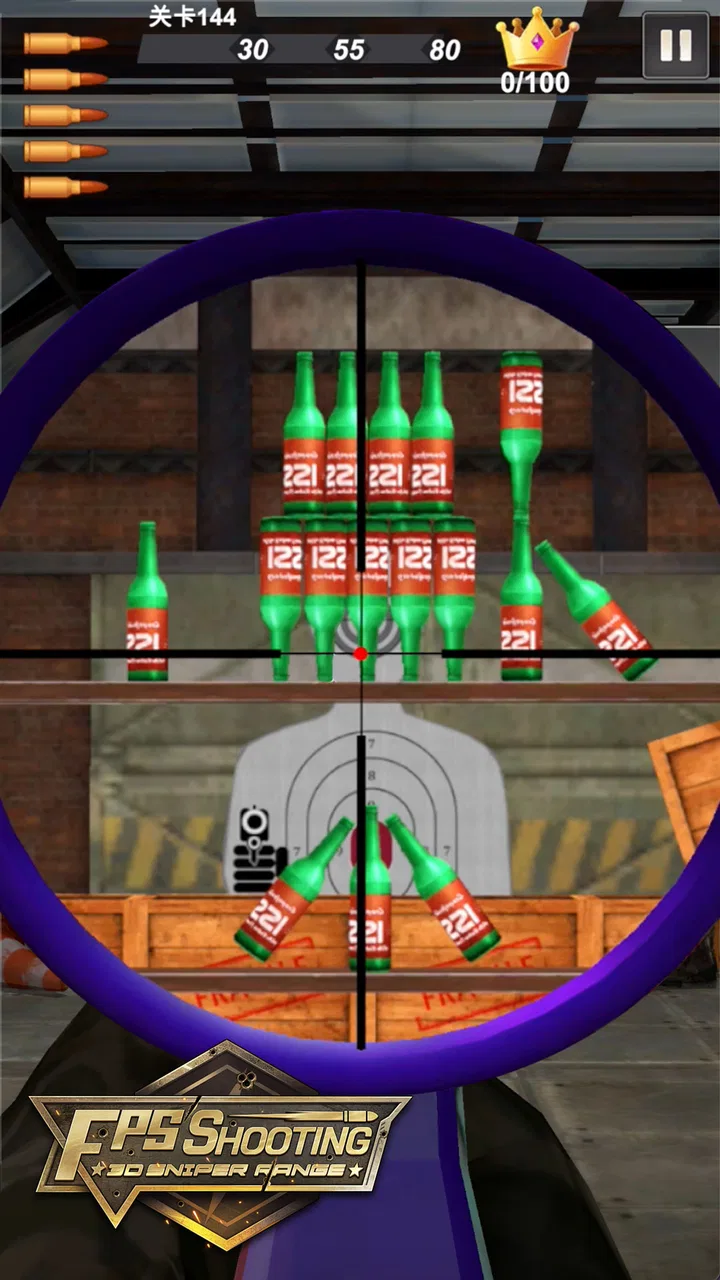
The store summary describes the goal as achieving mastery in sniper-rifle marksmanship, and that wording fits the intended mindset better than simply calling it an action game. I approached each attempt as a short exercise in control. Rather than firing as soon as the target appeared, I tried to settle the reticle, observe the target’s position and commit only when the shot felt deliberate.
The important strength is its narrow feedback loop: aim, fire, notice the mistake and adjust. That loop is useful because it makes improvement easier to understand. If I missed, I could think about whether I moved too quickly, aimed too far or simply lost focus. In a busier game, that kind of self-correction can be hidden beneath explosions and movement.
It feels closer to a range session than a full campaign
Players looking for a cinematic military story, squad commands or a large multiplayer battlefield should set their expectations differently. This is best understood as a shooting-range experience presented through a first-person perspective. Its value comes from concentration and repetition, not from creating a large world to explore.
That makes it particularly suitable for short sessions. I could play when I had only a few minutes and still feel that I had practiced a specific skill. The format also works for players who find large FPS games tiring because there are too many controls competing for attention. You do not need to remember a complicated loadout or manage a long mission before getting to the central action.
At the same time, the focused design can feel limited if you need constant novelty. Players who enjoy changing weapons, discovering maps or coordinating with teammates may find the range structure too restrained. The same simplicity that makes the game approachable can also make it less satisfying for someone who wants a complete shooter with several layers of progression.
How I would use the aiming focus in practice
I found it helpful to treat the first few attempts as calibration rather than performance tests. Instead of trying to produce a perfect result immediately, I paid attention to how much my finger movement affected the sight and how quickly I tended to rush. On a touchscreen, the temptation is to make a large correction when a small one would be enough. Deliberately using shorter movements gave me better control.
A useful routine is to pause briefly before each shot. That does not mean waiting forever; it means separating target recognition from firing. I first identified where the target was, then moved my aim, then checked the alignment before tapping. This simple sequence reduced accidental shots and made the game feel more like a test of discipline than reflex alone.
I also recommend playing with the phone held consistently. Changing grip between attempts makes it harder to tell whether a miss came from poor timing or an unstable hand position. Resting the device lightly against your palms, while keeping your thumbs or fingers free to aim, can make longer sessions less tiring. This is a small practical adjustment, but it matters more in a precision game than in a casual tap-based title.
What the experience is like during an ordinary session
Imagine waiting for an appointment with a few quiet minutes available. A large online shooter would be inconvenient because you might need to enter a match, learn the situation and remain available until the round ends. A focused sniper game is easier to pick up with that kind of schedule. You can concentrate on a small number of attempts, put the phone away and return later without feeling that you abandoned a team.
That is where I think the game makes the most sense in everyday use. It is not trying to fill an entire evening with a broad adventure. It gives you a contained target-practice activity, which suits short breaks, relaxed solo play and anyone who enjoys repeating a task until their control improves.
The same scenario also shows a limitation. If you are playing in a noisy place or while constantly being interrupted, precision becomes frustrating quickly. The game’s central skill depends on attention, so it does not provide the same easy background entertainment as a simple puzzle or idle game. It is casual in length, but not always casual in concentration.
Where it fits beside other mobile shooting games
Beside action-heavy FPS games, this one suits a different kind of break: I would pick it when I want a contained solo challenge, not a match full of movement and competing demands. Casual target games may be better when I am distracted, while a deeper simulator may suit someone seeking technical detail. That narrower role brings a few practical trade-offs into sharper view.
Compared with action-heavy FPS alternatives
The usual mobile FPS offers more variety: movement across larger spaces, faster encounters, multiple weapons and frequent visual stimulation. Those games are better when I want tension, unpredictability or a sense of being inside a larger battle. They also tend to provide more reasons to keep playing beyond improving one type of shot.
FPS Shooting: 3D Sniper Range has a different advantage. By placing marksmanship at the center, it removes much of the noise surrounding the shot. That can make it easier to focus on accuracy, especially for a new player who is still learning how touchscreen aiming feels. I would choose it over a full FPS when I want a controlled solo exercise rather than a hectic match.
The trade-off is depth. A broad shooter can keep surprising you through changing opponents, environments and tactical decisions. A range-focused game has fewer ways to disguise repetition. If the satisfaction of improving aim is not enough to hold your attention, the alternatives will probably feel richer over time.
Compared with casual target games
Simple target games are often more immediately accessible because they reduce aiming to quick taps or obvious visual prompts. They work well when the player wants a fast score chase with little pressure. This title appeals more to me when I want the act of positioning a shot to matter. The first-person shooting presentation gives the task more physical presence than a flat target board.
That presentation also means the game asks for more patience. A casual target game can be enjoyable even when I am distracted. Here, distracted play is more likely to produce careless shots. The right choice depends on whether you want a quick reflex toy or a more deliberate marksmanship exercise.
Compared with realistic simulation games
At the other end of the spectrum, serious simulation games may include extensive weapon behavior, detailed environmental factors and demanding controls. Those experiences can be rewarding for players who want technical realism, but they often require more time and patience than a mobile break allows.
This game occupies a more approachable middle ground in concept: it keeps the rifle focus without asking me to commit to a complicated simulation routine. That makes it easier to recommend to someone curious about sniper-style play but unwilling to learn a dense system. The compromise is that players seeking deep realism should look elsewhere, while players seeking a simple, focused session may appreciate the lighter structure.
The trade-offs I noticed while playing
The focused format is useful, but it does not remove the small frustrations of aiming on a touchscreen; a hurried correction or an inconsistent grip can make a shot feel less controlled. I also see repetition as a real test of fit: it helps when I want to refine a skill, but can wear thin if I expect varied encounters. A few simple habits can make that repetition feel more purposeful.
Precision can expose touchscreen friction
Touch controls are convenient, but they are not automatically ideal for fine aiming. A screen can feel responsive in one position and awkward in another, especially if the phone is small, the player’s hands are large or the display is being used under bright light. Because this game depends so heavily on a controlled shot, any uncertainty in the touch response becomes more obvious than it would in a fast arcade shooter.
I found that rushing was the biggest source of frustration. When I tried to correct my aim with a large swipe, I often moved past the point I wanted. Smaller adjustments were more reliable, but they required me to slow down. Players who prefer rapid flick shots may need time to adapt, and some will simply find the pace less enjoyable.
Repetition is both the training tool and the risk
Repeating similar actions is useful when the goal is to build consistency. It lets you compare one attempt with the next and notice habits that would be invisible in a chaotic match. However, repetition can also make the experience feel narrow. The game’s strongest feature is therefore also its main risk: if you enjoy refinement, it has a clear purpose; if you need constant changes, it may lose its appeal.
I would not install it expecting a long-form adventure. I would install it expecting a compact shooting activity that can be revisited whenever I want to work on controlled aiming. That expectation makes the free price especially easy to accept, because there is little commitment involved in trying its central idea.
Age rating and the right audience
The Teen content rating is worth considering for families deciding what belongs on a shared device. Although the game is presented as a sports-style marksmanship experience, it still uses a shooting theme, so it is not the same as a nonviolent sports title. Parents should make their own judgment based on the player’s age and comfort with firearm-focused gameplay.
For older players, the rating also signals that this is not aimed at very young children. I think teenagers and adults who enjoy precision challenges are the most natural audience. Younger children who mainly want colorful, forgiving games may find the aiming demands less enjoyable, even before considering the subject matter.
Small habits that make the focused design work better
I get more from the game when I keep each session calm and give myself one thing to work on, such as steadier aim rather than faster shots. Holding the phone consistently and taking a brief pause when my hand feels tense helps me judge attempts more fairly. Those habits do not add new systems; they make the existing marksmanship challenge easier to approach, which is useful when deciding whether it suits your play style.
Use short practice blocks instead of chasing a perfect run
One of my most useful adjustments was to stop treating every attempt as a final test. I played in short blocks, looked for one specific improvement and then took a break. For example, I might focus on keeping my reticle steady rather than worrying about speed. This approach made the game less stressful and turned misses into information.
That method is especially helpful on a phone because fatigue can arrive before the player notices it. As the hand becomes tense, movements become less precise and the natural response is often to press harder or move faster. A short pause can restore control more effectively than forcing another attempt.
Separate speed from accuracy
New players often assume that a faster shot is automatically a better shot. In a sniper-focused game, speed only matters after the basic alignment is reliable. I first tried to make clean, repeatable shots, then gradually reduced the time spent preparing. This created a better balance than chasing quick reactions immediately.
The trade-off is clear: a slower approach may feel less exciting, but it gives you a better understanding of your own mistakes. Once your movement is consistent, you can experiment with quicker decisions without losing the central discipline of the game.
Choose the right device setting for concentration
Because the title depends on visual alignment, I preferred playing when the screen was clean and the phone was held steadily. Finger placement matters too. Keeping the aiming finger away from the part of the display that needs to remain visible reduces the chance of obscuring the target at the wrong moment.
This is not a hidden feature or a special trick; it is a practical way to respect the game’s design. A player who treats the screen like a small range rather than a surface for frantic swiping will probably get more from it. The game rewards a calm physical setup as much as a quick reaction.
Who should try it and who should skip it
I would suggest trying it if you enjoy precision, short solo sessions and the satisfaction of making a repeated action feel more controlled. I would steer you toward a broader shooter if you want multiplayer competition, exploration or frequent changes in pace, and toward a simpler casual game if you plan to play while distracted. The deciding question is whether careful aiming itself sounds enjoyable to you.
The best match for this game
I would recommend it to someone who likes precision challenges, solo sports games and short sessions with a clear objective. It is also a sensible choice for a player who finds full mobile FPS games overwhelming and wants to isolate the aiming part first. Since it is free, trying that focused format does not require a purchase decision.
It may also suit players who enjoy measurable personal improvement. The satisfaction here comes from making a shot more controlled than the previous one, not necessarily from discovering a new world or defeating a complicated opponent. If that kind of incremental progress feels rewarding to you, the game has a straightforward reason to remain installed.
When another game would be better
I would skip it if your main reason for playing shooters is team competition, exploration or a large variety of weapons. You may also prefer a different option if you want a game that works well while distracted. This title asks for enough attention that casual background play can feel more irritating than relaxing.
Players who want advanced simulation should also keep their expectations measured. The sniper theme alone does not make a game a complete firearms simulator. Likewise, players who prefer instant arcade action may find the deliberate pace too restrained. The best alternative depends on the missing ingredient you care about: multiplayer pressure, story, realism or rapid reflex play.
My final view after focusing on its core strength
FPS Shooting: 3D Sniper Range succeeds when it stays close to its central idea. Its marksmanship focus gives each attempt a clear purpose and makes small improvements feel meaningful. I liked that I could approach it as a short practice session rather than a commitment to a long match or campaign. The free entry point also makes experimentation easy.
Its limitations are equally clear. A narrow shooting-range format cannot provide the variety of a full FPS, and touchscreen precision can be demanding when I am tired or distracted. The game is not the right answer for every shooter fan, but that is not a weakness by itself. It has chosen a specific experience instead of trying to cover every style of mobile shooting.
My recommendation is simple: try it if you want a focused way to practice careful aiming on Android and you enjoy repeating a skill until it feels cleaner. Approach it as a compact sports-style marksmanship game, not as a substitute for a large action shooter. With that expectation, HuanCai Studio’s game offers a focused and accessible challenge that can fit naturally into a quiet break.
FAQs for FPS Shooting: 3D Sniper Range
01What is the main objective of FPS Shooting: 3D Sniper Range?
The main objective of FPS Shooting: 3D Sniper Range is to improve your shooting skills by completing various sniper missions. Players aim to hit targets accurately within challenging environments, enhancing both precision and timing. The game offers different levels and difficulties to test your shooting abilities and strategic thinking.
02How are the graphics and controls in FPS Shooting: 3D Sniper Range?
FPS Shooting: 3D Sniper Range boasts realistic 3D graphics that immerse players in diverse environments. The controls are intuitive, allowing users to easily aim and shoot with precision. Adjustable sensitivity settings cater to different player preferences, ensuring a smooth gaming experience for both beginners and experienced shooters.
03Are there any in-app purchases or ads in FPS Shooting: 3D Sniper Range?
Yes, FPS Shooting: 3D Sniper Range includes in-app purchases that allow players to unlock advanced weapons and gear. While the core game is free, players can opt to enhance their experience through these purchases. Additionally, there are ads, but they can be removed with a premium upgrade for an uninterrupted gaming experience.
04Does FPS Shooting: 3D Sniper Range offer multiplayer options?
Currently, FPS Shooting: 3D Sniper Range focuses on a single-player experience with a variety of missions and challenges. While multiplayer options are not available at the moment, the game’s extensive solo content keeps players engaged as they strive to achieve higher scores and unlock new levels.
05Is FPS Shooting: 3D Sniper Range suitable for all ages?
FPS Shooting: 3D Sniper Range is designed for a mature audience due to its shooting and combat themes. It's recommended for players aged 16 and above. Parents should consider the game’s content and in-app purchase options when deciding if it’s appropriate for younger players.
Pros
- Realistic 3D graphics enhance gameplay.
- Wide range of sniper rifles available.
- Intuitive controls for easy navigation.
- Engaging missions with diverse challenges.
- Offline mode available for play anywhere.
Cons
- Ads can be intrusive during gameplay.
- Limited customization for characters.
- In-app purchases can be pricey.
- Some levels feel repetitive over time.
- Requires frequent updates for bug fixes.

FPS Shooting: 3D Sniper Range
Gallery